
Saturday, 17 October 2009


Friday, 16 October 2009
Brit ISP TalkTalk shows why cutting people off because a record exec says they're file-sharers is dumb
Brit ISP TalkTalk shows why cutting people off because a record exec says they're file-sharers is dumb: "
The British ISP TalkTalk has produced a compelling case against the government's plans to disconnect whole households from the Internet if the copyright industry accuses them -- without proving anything in court -- of three acts of infringement. TalkTalk picked a random street in North London and showed that 23 of the households in that road were using WEP security to stop strangers from accessing their networks. WEP has been thoroughly broken for years, but many older games consoles, phones and other devices are only capable of using WEP to connect to WiFi networks. TalkTalk argues that householders who have done everything they can to secure their networks from people who want to use them for cover during illegal file-sharing are still vulnerable to being disconnected by record- and film-company execs.
Households that are subjected to this form of collective punishment -- 'someone around here broke the law, so you'll all suffer' -- lose access to the net, and with it, connectivity related to their employment, education, family connections, health, and government. All on the unsubstantiated say-so of the same entertainment companies that have previously accused a laser-printer of illegally downloading an Indiana Jones movie, not to mention the small legion of dead people; ancient, non-computer-owning grannies; and other innocents who've been legally threatened by the music industry for alleged copyright infringement.
A rep from the record industry insists that he has bought some magic beans 'robust' evidence-gathering software that will never, ever cut someone off from the Internet on false pretences, so we don't need judges or evidence or trials or any of that messy business. But, of course, if someone is hacking your WiFi without your knowledge, he's prepared to cut you off from the Internet, because 'the responsibility for ensuring that an internet account shared throughout a household is not being used for illegal filesharing clearly lies with the account holder.'
I think I will sue Royal Mail...
I have bought a battery for my phone. This is being shipped from Hong Kong. This battery I bought from eBay. The seller's ad told me it would take between 8-16 days for me to receive the battery.
In the vague hope that I will somehow get it before then I have been ringing home everyday since, sometimes twice a day, to inquire if the battery had come. As of today, the 10th day, it hasn't.
I don’t blame the seller. I am sure he has, in all honesty, sent the battery to me. The jackasses I do blame are the people who call themselves the Royal Mail.
They have recently gone on strike because apparently they aren’t being paid that much. Lazy SOB's. Also they want their working conditions to be improved. For fuck's sake, how hard is it to shift an envelope from one slot to another. Imagine if the people building the pyramids had said this to the Pharaoh. You know what would have happened! I’m not saying anymore!
Royal Mail should be sued by me...and every other person who is expecting something important that has not arrived. What say you?
In the vague hope that I will somehow get it before then I have been ringing home everyday since, sometimes twice a day, to inquire if the battery had come. As of today, the 10th day, it hasn't.
I don’t blame the seller. I am sure he has, in all honesty, sent the battery to me. The jackasses I do blame are the people who call themselves the Royal Mail.
They have recently gone on strike because apparently they aren’t being paid that much. Lazy SOB's. Also they want their working conditions to be improved. For fuck's sake, how hard is it to shift an envelope from one slot to another. Imagine if the people building the pyramids had said this to the Pharaoh. You know what would have happened! I’m not saying anymore!
Royal Mail should be sued by me...and every other person who is expecting something important that has not arrived. What say you?
I will be writing again...
Ok so I have not posted anything of my own for a while.
In the selfish drive of gaining more readers to this blog I have often posted stuff from other peoples blog's and websites. This has been quite easy for me to do. Using the "send to" button google reader has made it much more easier.
However, I do admit that I have neglected the people who came to this blog to read what I wrote.
So I will be writing again soon. And the other colourful shit that you see on this blog I will keep to a few posts a day!!
In the immortal words of the muscley one...."I'll be Back"!
In the selfish drive of gaining more readers to this blog I have often posted stuff from other peoples blog's and websites. This has been quite easy for me to do. Using the "send to" button google reader has made it much more easier.
However, I do admit that I have neglected the people who came to this blog to read what I wrote.
So I will be writing again soon. And the other colourful shit that you see on this blog I will keep to a few posts a day!!
In the immortal words of the muscley one...."I'll be Back"!
No One Wanted to Claim Rocket Launcher
No One Wanted to Claim Rocket Launcher: "
 Jarrette Schule found a rocket launcher in his backyard in rural Comal County, Texas on Tuesday. Against all common sense, he took it in his house, then began calling authorities to report it. He called the FBI, the sheriff’s department, and Homeland Security.
“Everyone was handing it off to everybody else,” Schule said.
He was surprised at the amount of work it took to get the military to pick up its lost missile launcher.
Schule initially was nervous when he found the weapon. But as the hours passed, he did what most guys would do — marvel at the mind-blowing awesomeness of finding a missile launcher. He posted photos on Facebook and called his buddies, saying: “Guess what I found?”
Schule called the military police at Fort Sam. But their jurisdiction doesn’t extend off the post. Schule’s information was passed along to an Army criminal investigator, who visited Schule on Wednesday morning — about 19 hours after he started making phone calls.
Three hours later, an Army ordinance disposal team retrieved the weapon. There is still no word on how it got to Schule’s yard. Link -via Queuebot
The Dark Sword UAV - Chinese Knockoffs Can Be Better Than the Real Thing [Uav]
The Dark Sword UAV - Chinese Knockoffs Can Be Better Than the Real Thing [Uav]: "
 The Chinese military has apparently been copying American UAV designs for a while now. After they got bored simply rebuilding Uncle Sam's models, they decided to design a few of their own. And they blow ours out of the water.
Above is the Dark Sword, the Chinese military's newest drone. Not only does it look a lot cooler than any American model, it's apparently much more maneuverable and highly capable in air-to-air combat. This is on top of the Chinese having carbon copies of the Predator and Global Hawk UAVs ready to go in their arsenal.
Not to mention the names are much more awesome. How cool is the phrase 'Dark Sword?' Or better yet, 'Sour Dragon?' Seriously. [DefPro via Wired via PopSci]

222 – The fastest pun in the west
222 – The fastest pun in the west: "

He should have been educated not to do this, but he was tragically just too cool for school.



Thursday, 15 October 2009
William Dalrymple- The White/ (last) Mughal
Special Feature – William Dalrymple, The White Mughal: "The Delhi walla's pretension in writing makes me want to lodge a bullet in his balls - Blogger Nimpipi, the woodchuck chucks
GO STRAIGHT TO MORE STORIES
Contact mayankaustensoofi@gmail.com for ad enquiries.

Delhi’s most famous expat author.
[Text and pictures by Mayank Austen Soofi]
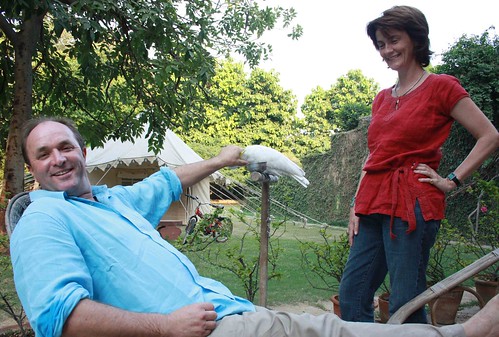
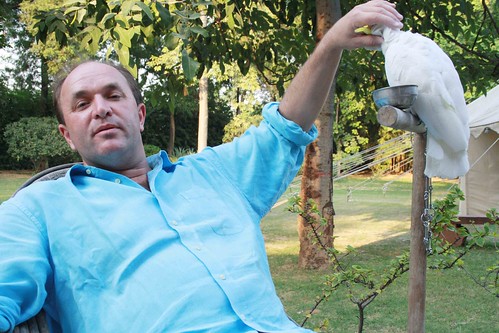
William Dalrymple has a big paunch. When The Delhi Walla met the Delhi-based British author at his Mira Singh farmhouse off the Mehrauli-Gurgaon highway, he was lounging on a wicker chair in his garden.
Looking like a white nabab, Mr Dalrymple is as popular. India International Center fills up each time he speaks. His articles are published in literary journals such as The New Yorker.
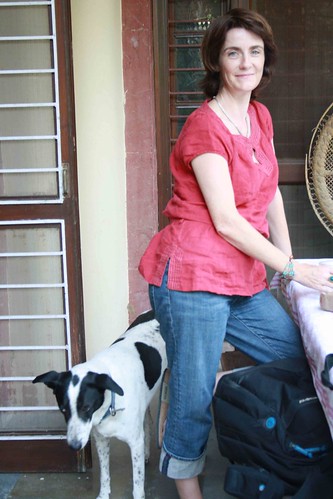
Mr Dalrymple’s bitch, Aishwarya, was barking; his bird Albinia was kissing him on the lips; his children were playing with goats and cocks; his wife, Olivia, had returned from a walk. The latest New York Review of Books was on the table, along with his latest work, Nine Lives – In Search of the Sacred in Modern India. It needed eight translators to make Nine Lives. Even after living in Delhi on-and-off for 25 years, Mr Dalrymple has not learned Hindi or any other Indian language.
“I know, I know...” he laughs while stroking Albinia’s beak. “My Hindi is terrible.”
Quite a few question Mr Dalrymple’s expertise about India. Historian Sunil Khilnani mockingly credited him for creating the genre ‘Bollywood history’. Ramchandra Guha said that his “knowledge of this country is so superficial.”
Is it?
“Westerners have written on India to suit their own prejudices but I avoid that,” Mr Dalrymple says. “For instance, in Nine Lives, I‘ve let people speak.” In the book, Mr Dalrymple follows the spiritual pursuits of nine people, including a jain monk, a tantric skull feeder, and a devdasi. “The whole point was to humanise and demystify such entities,” he says, “The mundane mingles with the exotic.”
Why is Dalrymple’s India always exotic? The City of Djinns, his award-winning travelogue on Delhi, starts with a sufi whose “beard is as tangled as a myna’s nest” and ends with a sanyasi “dancing like a madman.”
“But India is exotic,” he says. “In the West, you see the homeless outside the malls, here you see them at the cremation grounds.” However, he dismisses the charges of exoticism as unfair. “My imagination is not that of a doped orientalist,” he says. “The Mughals dressed the way they did and I did not make that up in my previous books.”
Mr Dalrymple is considering a biography of Aurangzeb, the Mughal emperor infamous for his religious bigotry. “The young Aurangzeb was a very different person than what he later changed into and as stereotyped by Indian historians,” Mr Dalrymple says. “If Babur was a great diarist, Aurangzeb was a great letter writer. He was like a Shakespearean character, like the bastard Edmund in King Lear. Unloved by his father, he lived old enough to realise that he had fucked up the empire.”
Historians usually are not so engaging while talking of kings and empires.
“There is a singular quality about William Dalrymple's 'brand' of writing,” says author Rakhshanda Jalil whose PhD subject deals with the progressive writers’ movement in India and its impact on popular culture. “He makes history readable to a lay reader in a manner a conventional historian can not.”
I earlier turned to Bombay-based writer Aakar Patel to get more views on Delhi’s most famous expat author. He reads Indian history books written in English as well as in Hindi, Gujarati and Marathi. Perhaps he could compare Mr Dalrymple with those who write in regional languages and are not read widely. Mr Patel e-mailed saying he has never read the author, despite buying most of his books.
“Perhaps this is prejudice, but it is borne out of an incident. I saw him on BBC many years ago, doing a documentary on the Delhi riots after Babri Masjid was pulled down. He gets into a taxi and tries to speak to the driver in Hindi, but what comes out is gibberish. He then reverts to English to the cabbie’s relief. He's driven to the walled city, I think, to one of the mohallas behind Jama Masjid. A charpai is brought out and he asks the elders for their reactions. One of them says that a mob threatened to attack them. “Were they Shiv Sainiks?” Dalrymple asks eagerly. (Shiv Sainiks are members of a regional right-wing extremist party not active in Delhi) At that point I switched the TV off, and haven't really been able to switch back on to him. My loss, doubtless.”
But another man gained a wife thanks to Mr Dalrymple’s works. “The Last Mughal brought us together,” said Jacob Anil Rose, a Delhi-based consultant whose contribution to Italian-Indian business ventures got him knighthood in Rome a few years ago. Both he and his future wife were listed on a marriage portal. On discovering that she liked reading, he sent her a mail praising The Last Mughal. She responded. Discussions followed, passions flared, they met, fell in love, married.
“Dalrymple makes history come alive for me,” said Mr Rose, adding, “He subtly combines fact with fiction.”
I then called publisher Jaya Bhattacharya Rose, his wife. “All said, Dalrymple has added layers to Delhi’s identity,” she said. “He makes the past approachable by turning it into living history.”
Coming back to his farmhouse, Mr Dalrymple asserts that Nine Lives is about the ‘real India’ of villages and small towns. “(Author) Pankaj Mishra told me that this is the India that he grew up in but never saw in print before,” he says.
By now it was evening and this being October, there was a slight chill in the air. “In the winter,” Mr Dalrymple says, “I like going to the Mehrauli Archeological Park around Jamali Kamali and the Safdarjung’s Tomb for dog-walks and picnics.”
Since he first came to Delhi in 1984, is he fit to be labelled a Delhiwalla?
“That’s a classic immigrant conundrum,” Mr Dalrymple says. “To a certain extent, you always remain a stranger but as a writer that’s an asset.”
Mr and Mrs Dalrymple, and Albinia
Aishwarya and Mrs Dalrymple
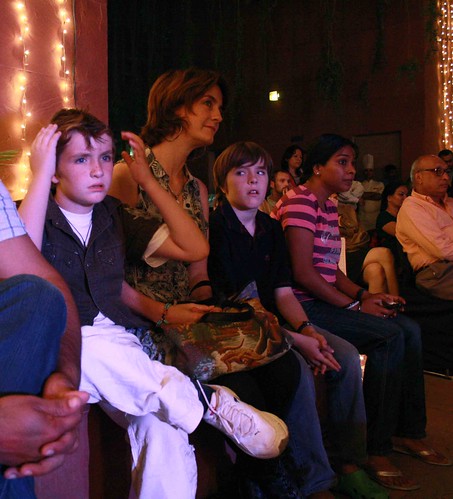
The Dalrymple family in the launch of Nine Lives
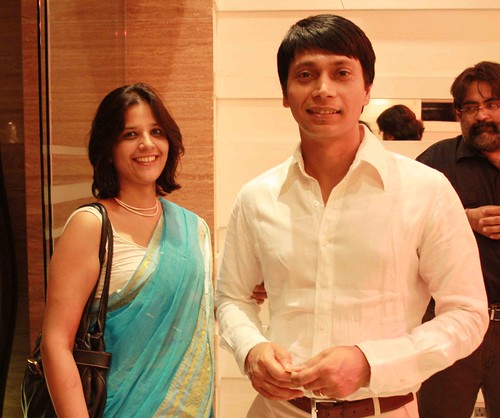
Mrs and Mr Rose
The White Mughal
Courtesy of The Delhi Walla
GO STRAIGHT TO MORE STORIES
Contact mayankaustensoofi@gmail.com for ad enquiries.
Delhi’s most famous expat author.
[Text and pictures by Mayank Austen Soofi]
William Dalrymple has a big paunch. When The Delhi Walla met the Delhi-based British author at his Mira Singh farmhouse off the Mehrauli-Gurgaon highway, he was lounging on a wicker chair in his garden.
Looking like a white nabab, Mr Dalrymple is as popular. India International Center fills up each time he speaks. His articles are published in literary journals such as The New Yorker.
Mr Dalrymple’s bitch, Aishwarya, was barking; his bird Albinia was kissing him on the lips; his children were playing with goats and cocks; his wife, Olivia, had returned from a walk. The latest New York Review of Books was on the table, along with his latest work, Nine Lives – In Search of the Sacred in Modern India. It needed eight translators to make Nine Lives. Even after living in Delhi on-and-off for 25 years, Mr Dalrymple has not learned Hindi or any other Indian language.
“I know, I know...” he laughs while stroking Albinia’s beak. “My Hindi is terrible.”
Quite a few question Mr Dalrymple’s expertise about India. Historian Sunil Khilnani mockingly credited him for creating the genre ‘Bollywood history’. Ramchandra Guha said that his “knowledge of this country is so superficial.”
Is it?
“Westerners have written on India to suit their own prejudices but I avoid that,” Mr Dalrymple says. “For instance, in Nine Lives, I‘ve let people speak.” In the book, Mr Dalrymple follows the spiritual pursuits of nine people, including a jain monk, a tantric skull feeder, and a devdasi. “The whole point was to humanise and demystify such entities,” he says, “The mundane mingles with the exotic.”
Why is Dalrymple’s India always exotic? The City of Djinns, his award-winning travelogue on Delhi, starts with a sufi whose “beard is as tangled as a myna’s nest” and ends with a sanyasi “dancing like a madman.”
“But India is exotic,” he says. “In the West, you see the homeless outside the malls, here you see them at the cremation grounds.” However, he dismisses the charges of exoticism as unfair. “My imagination is not that of a doped orientalist,” he says. “The Mughals dressed the way they did and I did not make that up in my previous books.”
Mr Dalrymple is considering a biography of Aurangzeb, the Mughal emperor infamous for his religious bigotry. “The young Aurangzeb was a very different person than what he later changed into and as stereotyped by Indian historians,” Mr Dalrymple says. “If Babur was a great diarist, Aurangzeb was a great letter writer. He was like a Shakespearean character, like the bastard Edmund in King Lear. Unloved by his father, he lived old enough to realise that he had fucked up the empire.”
Historians usually are not so engaging while talking of kings and empires.
“There is a singular quality about William Dalrymple's 'brand' of writing,” says author Rakhshanda Jalil whose PhD subject deals with the progressive writers’ movement in India and its impact on popular culture. “He makes history readable to a lay reader in a manner a conventional historian can not.”
I earlier turned to Bombay-based writer Aakar Patel to get more views on Delhi’s most famous expat author. He reads Indian history books written in English as well as in Hindi, Gujarati and Marathi. Perhaps he could compare Mr Dalrymple with those who write in regional languages and are not read widely. Mr Patel e-mailed saying he has never read the author, despite buying most of his books.
“Perhaps this is prejudice, but it is borne out of an incident. I saw him on BBC many years ago, doing a documentary on the Delhi riots after Babri Masjid was pulled down. He gets into a taxi and tries to speak to the driver in Hindi, but what comes out is gibberish. He then reverts to English to the cabbie’s relief. He's driven to the walled city, I think, to one of the mohallas behind Jama Masjid. A charpai is brought out and he asks the elders for their reactions. One of them says that a mob threatened to attack them. “Were they Shiv Sainiks?” Dalrymple asks eagerly. (Shiv Sainiks are members of a regional right-wing extremist party not active in Delhi) At that point I switched the TV off, and haven't really been able to switch back on to him. My loss, doubtless.”
But another man gained a wife thanks to Mr Dalrymple’s works. “The Last Mughal brought us together,” said Jacob Anil Rose, a Delhi-based consultant whose contribution to Italian-Indian business ventures got him knighthood in Rome a few years ago. Both he and his future wife were listed on a marriage portal. On discovering that she liked reading, he sent her a mail praising The Last Mughal. She responded. Discussions followed, passions flared, they met, fell in love, married.
“Dalrymple makes history come alive for me,” said Mr Rose, adding, “He subtly combines fact with fiction.”
I then called publisher Jaya Bhattacharya Rose, his wife. “All said, Dalrymple has added layers to Delhi’s identity,” she said. “He makes the past approachable by turning it into living history.”
Coming back to his farmhouse, Mr Dalrymple asserts that Nine Lives is about the ‘real India’ of villages and small towns. “(Author) Pankaj Mishra told me that this is the India that he grew up in but never saw in print before,” he says.
By now it was evening and this being October, there was a slight chill in the air. “In the winter,” Mr Dalrymple says, “I like going to the Mehrauli Archeological Park around Jamali Kamali and the Safdarjung’s Tomb for dog-walks and picnics.”
Since he first came to Delhi in 1984, is he fit to be labelled a Delhiwalla?
“That’s a classic immigrant conundrum,” Mr Dalrymple says. “To a certain extent, you always remain a stranger but as a writer that’s an asset.”
Mr and Mrs Dalrymple, and Albinia
Aishwarya and Mrs Dalrymple
The Dalrymple family in the launch of Nine Lives
Mrs and Mr Rose
The White Mughal
Courtesy of The Delhi Walla
Saudi rural women's freedom to drive cars and trucks under renewed threat
Saudi rural women's freedom to drive cars and trucks under renewed threat: "Perhaps one of the most misunderstood aspects of Saudi society in the non-Arab world is the myth that all Saudi women are banned from driving cars. Read any English-language news periodical and the message is absolute: It’s illegal for Saudi women to drive.
Well, that’s kinda-sorta-usually-but-not-always true.
For decades, Saudi women have been driving on highways and streets outside of urban areas. They must drive because their families’ survival depends on it. While men are working, wives are tasked with taking the kids to school, transporting livestock to market, and managing the house. They also drive big tankers to bring drinking water to their villages. Many of these women are also Bedouins who travel from village to village earning a living by transporting goods.
This is not a case of heading down to the local Danube supermarket for a box of corn flakes. This is a long drive, sometimes hundreds of miles, over a harsh desert environment usually in a 2-ton Mercedes truck or a Hilux pickup. These moms, some who arm themselves with a handgun for protection while driving alone, are a hardworking, tough lot that can handle a truck better than most men.
I remember as a child my uncle in one of the Yanbu villages going to work at 4 each morning, leaving the management of the house, the family and the harvesting of their crops to my aunt. She drove all over the region to make sure not only her kids but the extended family were cared for.
As a practical issue, the police and Hiy’a (Commission for the Promotion of Virtue and Prevention of Vice, commonly referred to as the religious police) can’t effectively patrol these remote areas. For the most part, women have had free reign in driving vehicles where they please.
Common sense, which is not always a prime ingredient when journalists address perceived wrongs with Saudi Arabia, tells us that it’s impractical and dangerous to ban all Saudi women from driving. Of course, Saudi conservatives, and that includes some members of the Commission, share the same problem.
Although rural women have had it pretty easy on the roads, apparently there can be too much of a good thing. Last week, the Hiy’a filed a complaint with the administrative ruler of the Hail region in which they asked him to ban 15 village women from driving their cars and trucks. Now, women who make sure the family’s chickens and goats get to market and keep the village supplied with water, are without transportation.
These women can’t hire a driver because their primary means of transportation is a pickup truck, which forces them into a state of khalwa -- or seclusion with a non-relative male -- as they sit beside the driver.
Consider what is more dangerous: a woman driving a truck or a woman alone with a male stranger in the middle of nowhere. The female breadwinner is faced with the double whammy of being denied the right to use a vehicle to contribute to the household income and the
right to hire a driver as a solution to her economic problem.
Many Saudis support the idea of enforcement of our moral and religious obligations. Indeed, it’s addressed in the Qur’an. But it’s quite another thing to mess with hardworking families who depend on the motor vehicle to make ends meet. For decades Saudi law authorities recognized that ranch and farm families were an exception to the driving ban edict because a family’s livelihood depended on a vehicle. They understandably turned a blind eye. That right apparently has been taken from them for no reason other than the conservatives feel threatened by it.
Saudi Arabia is in a period of great transition, and there is an expectation of movement forward, not backward. Naturally there are many people who prefer the comfort of the past. Perhaps forcing working rural women to return to camels and donkeys as transportation makes some people feel more comfortable. But their comfort comes at the expense of the working family.
Well, that’s kinda-sorta-usually-but-not-always true.
For decades, Saudi women have been driving on highways and streets outside of urban areas. They must drive because their families’ survival depends on it. While men are working, wives are tasked with taking the kids to school, transporting livestock to market, and managing the house. They also drive big tankers to bring drinking water to their villages. Many of these women are also Bedouins who travel from village to village earning a living by transporting goods.
This is not a case of heading down to the local Danube supermarket for a box of corn flakes. This is a long drive, sometimes hundreds of miles, over a harsh desert environment usually in a 2-ton Mercedes truck or a Hilux pickup. These moms, some who arm themselves with a handgun for protection while driving alone, are a hardworking, tough lot that can handle a truck better than most men.
I remember as a child my uncle in one of the Yanbu villages going to work at 4 each morning, leaving the management of the house, the family and the harvesting of their crops to my aunt. She drove all over the region to make sure not only her kids but the extended family were cared for.
As a practical issue, the police and Hiy’a (Commission for the Promotion of Virtue and Prevention of Vice, commonly referred to as the religious police) can’t effectively patrol these remote areas. For the most part, women have had free reign in driving vehicles where they please.
Common sense, which is not always a prime ingredient when journalists address perceived wrongs with Saudi Arabia, tells us that it’s impractical and dangerous to ban all Saudi women from driving. Of course, Saudi conservatives, and that includes some members of the Commission, share the same problem.
Although rural women have had it pretty easy on the roads, apparently there can be too much of a good thing. Last week, the Hiy’a filed a complaint with the administrative ruler of the Hail region in which they asked him to ban 15 village women from driving their cars and trucks. Now, women who make sure the family’s chickens and goats get to market and keep the village supplied with water, are without transportation.
These women can’t hire a driver because their primary means of transportation is a pickup truck, which forces them into a state of khalwa -- or seclusion with a non-relative male -- as they sit beside the driver.
Consider what is more dangerous: a woman driving a truck or a woman alone with a male stranger in the middle of nowhere. The female breadwinner is faced with the double whammy of being denied the right to use a vehicle to contribute to the household income and the
right to hire a driver as a solution to her economic problem.
Many Saudis support the idea of enforcement of our moral and religious obligations. Indeed, it’s addressed in the Qur’an. But it’s quite another thing to mess with hardworking families who depend on the motor vehicle to make ends meet. For decades Saudi law authorities recognized that ranch and farm families were an exception to the driving ban edict because a family’s livelihood depended on a vehicle. They understandably turned a blind eye. That right apparently has been taken from them for no reason other than the conservatives feel threatened by it.
Saudi Arabia is in a period of great transition, and there is an expectation of movement forward, not backward. Naturally there are many people who prefer the comfort of the past. Perhaps forcing working rural women to return to camels and donkeys as transportation makes some people feel more comfortable. But their comfort comes at the expense of the working family.
Ardi, In-Depth
Ardi, In-Depth: "
You'll recall (hopefully) Ardi, the Ardipithecus ramidus, an ancient human ancestor that's recently gotten a whole lot of media attention. Excellently pseudo-named blogger Zinjanthropus (actually a mild-mannered biological anthropology grad student) is doing a series of posts that take a close-up look at some of the biological quirks that make Ardi such a surprise.
The first post is on Ardi's hands...
The extant African apes are knuckle-walkers, they have stiff, inflexible hands and wrists that allow them to support their body weight in sort of a weird position. Because they also have to climb trees for food and protection, their hands are very long and powerful. Humans, on the other hand, have pretty mobile hands and wrists which allows us what we call a 'power grip.' We are very good graspers, and this has allowed us to become the dexterous tool-wielders that we are. Because of our close genetic similarity to chimps, and the close morphological similarity between chimps and gorillas, it has been argued that certain features of the Australopithecine wrist- and even the human wrist- were 'hold overs' from the period of time when we, too were knuckle-walkers who required a stiff wrist and hand.
However, Ardi's hand more closely approximates the human hand than the knuckle-walker hand."
Subscribe to:
Posts (Atom)